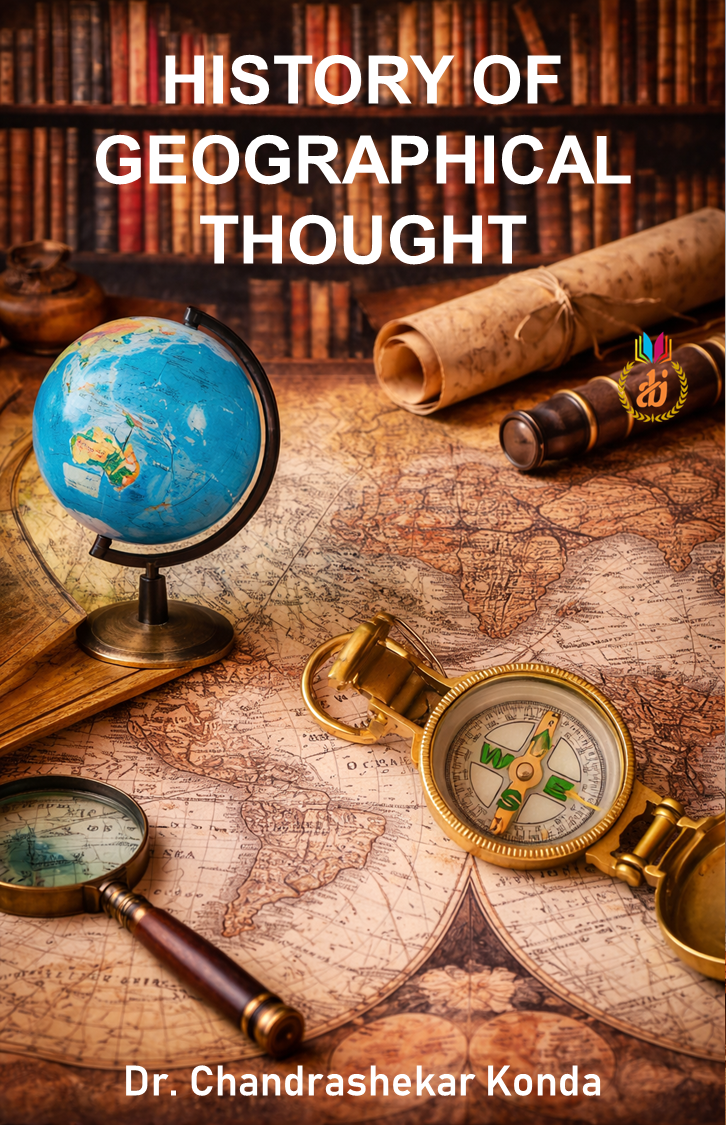
History of Geographical Thought is a comprehensive and scholarly work authored by Dr. Chandrashekhar Konda that examines the historical evolution, philosophical foundations, and intellectual development of geographical ideas from ancient civilizations to contemporary geographical paradigms. The book presents geography not merely as the study of places and landscapes, but as a dynamic discipline shaped by changing human perceptions, scientific advancements, political transformations, and cultural interactions across different periods of history. Written in a systematic and student-friendly style, the work is especially useful for undergraduate and postgraduate students of Geography, researchers, teacher trainees, and aspirants preparing for competitive examinations such as UGC-NET, SET, UPSC, and state civil services examinations.
The book traces the origin and growth of geographical thought beginning with the contributions of Greek scholars such as Eratosthenes, Strabo, Ptolemy, and Herodotus, whose observations laid the intellectual foundations of geographical inquiry. It further discusses the role of Roman, Arab, Medieval European, and Renaissance scholars in preserving and expanding geographical knowledge during different historical phases. Special attention has been given to the Age of Exploration and the Scientific Revolution, which transformed geography into a more analytical and systematic discipline. The work critically evaluates the contributions of major modern geographers including Alexander von Humboldt, Carl Ritter, Friedrich Ratzel, Vidal de la Blache, Halford Mackinder, Richard Hartshorne, and others whose theories significantly influenced the development of physical, regional, political, and human geography.
A distinctive feature of the book is its balanced treatment of both classical and contemporary approaches in geography. The text explains important concepts such as environmental determinism, possibilism, neo-determinism, regionalism, quantitative revolution, behavioral geography, radical geography, welfare geography, humanistic geography, feminist geography, and postmodern geographical perspectives in a clear and analytical manner. The author also highlights how geographical thought evolved from descriptive traditions to scientific methodologies incorporating spatial analysis, technological innovations, and interdisciplinary approaches. The inclusion of maps, conceptual explanations, comparative interpretations, and critical discussions enhances the academic value of the book and helps readers understand the transformation of geography through different intellectual traditions.
Designed according to university curricula and modern academic requirements, the book combines theoretical depth with accessible language, making complex geographical ideas understandable for students from diverse educational backgrounds. It serves not only as a historical account of geographical ideas but also as an intellectual guide to understanding the changing nature, scope, and relevance of geography in the contemporary world. Through its comprehensive coverage and analytical presentation, the book contributes significantly to the study of geographical philosophy and the continuing evolution of geographical knowledge.